
Simvoly at a glance
- Our score
- 3.0 out of 5, ranked #20 of 22
- Free plan rating
- 1.5 out of 5
- Strongest at
- features (4.2)
- Weakest at
- free plan (1.5)
- User rating
- 4.0 out of 5 on Trustpilot from 11 reviews
- Can you leave?
- Partly, content only. Store and contact data only. See how every builder compares
- Last checked
- July 2026
Simvoly Review 2026: Capable Platform, Confusing to Use
Simvoly packs a website builder, a sales funnel builder, a CRM, email marketing, memberships and a store into one subscription, and on paper that is a lot of value for the money. In practice we found it harder to navigate than almost any builder on this list, with responsive layouts you have to build three times over and no free plan to fall back on. It is a strong tool for agencies and a frustrating one for a solo user who just wants a website.
Overview
Simvoly is a Bulgarian platform that launched in 2016 after roughly two years of development. It started life as a straightforward drag-and-drop website builder and has since grown into something much broader: a bundle that covers websites, sales funnels, ecommerce, a CRM, email and SMS marketing, memberships and online communities, video hosting, quizzes, and appointment booking. The company states it has more than 20,000 active users and over 1,000 partners reselling the software across 81 countries. Those are vendor figures with no independent verification, so treat them as marketing rather than audited numbers.
The Product Has Shifted Toward Agencies
This matters more than most reviews acknowledge. Simvoly's own homepage now leads with the phrase white label website and funnel builder for agencies, not with anything aimed at an individual building their first site. The white label tiers let you strip Simvoly's branding entirely, put your own logo on the platform, and resell it to clients under your name. Three of the seven plans on the pricing page exist purely for that use case. Once you understand that the reseller is the target customer, the product's design choices make far more sense, and so does the friction a solo user runs into.
Who It Suits, and Who It Does Not
Simvoly is a reasonable fit if you are a marketer, coach, course seller or small agency who needs a landing page, a funnel behind it, an email sequence after that, and a place to keep the contacts, and who would otherwise be paying for three or four separate tools. The bundled price genuinely undercuts stitching together a page builder, an email platform and a CRM.
It is a poor fit if you want a website and nothing else. You will pay for a large amount of machinery you never touch, navigate a dashboard built around that machinery, and hand-maintain three layouts per page. For that job, Webador, SITE123 or Wix will get you further in an afternoon, and all three have a free tier you can test indefinitely.
Simvoly Free Plan
There is no Simvoly free plan. What exists is a 14-day free trial that does not ask for a credit card, and Simvoly permits a new trial per project rather than one per account, so you can genuinely evaluate the platform more than once. Annual subscriptions also come with a 14-day money-back guarantee, which monthly subscriptions do not.
What the Trial Does Not Cover
Two weeks is not much time to evaluate a platform this wide. In our testing the trial went mostly on working out where things live rather than on building, and the parts of Simvoly that justify its price (funnel sequences, email automations, membership areas) are exactly the parts that take longest to set up and understand. You cannot publish to a custom domain during the trial either, so you are not testing the real thing end to end.
Why This Scores 1.5
Our free plan score reflects what you can keep for free forever, and with Simvoly that is nothing. It sits alongside Squarespace and Hostinger as a trial-only platform. Because free plan quality carries the heaviest weight in our scoring, that single fact costs Simvoly more than any other shortcoming in this review. If a permanent free tier is what you came here for, this is not the platform, and no amount of bundled features changes that.
Ease of Use
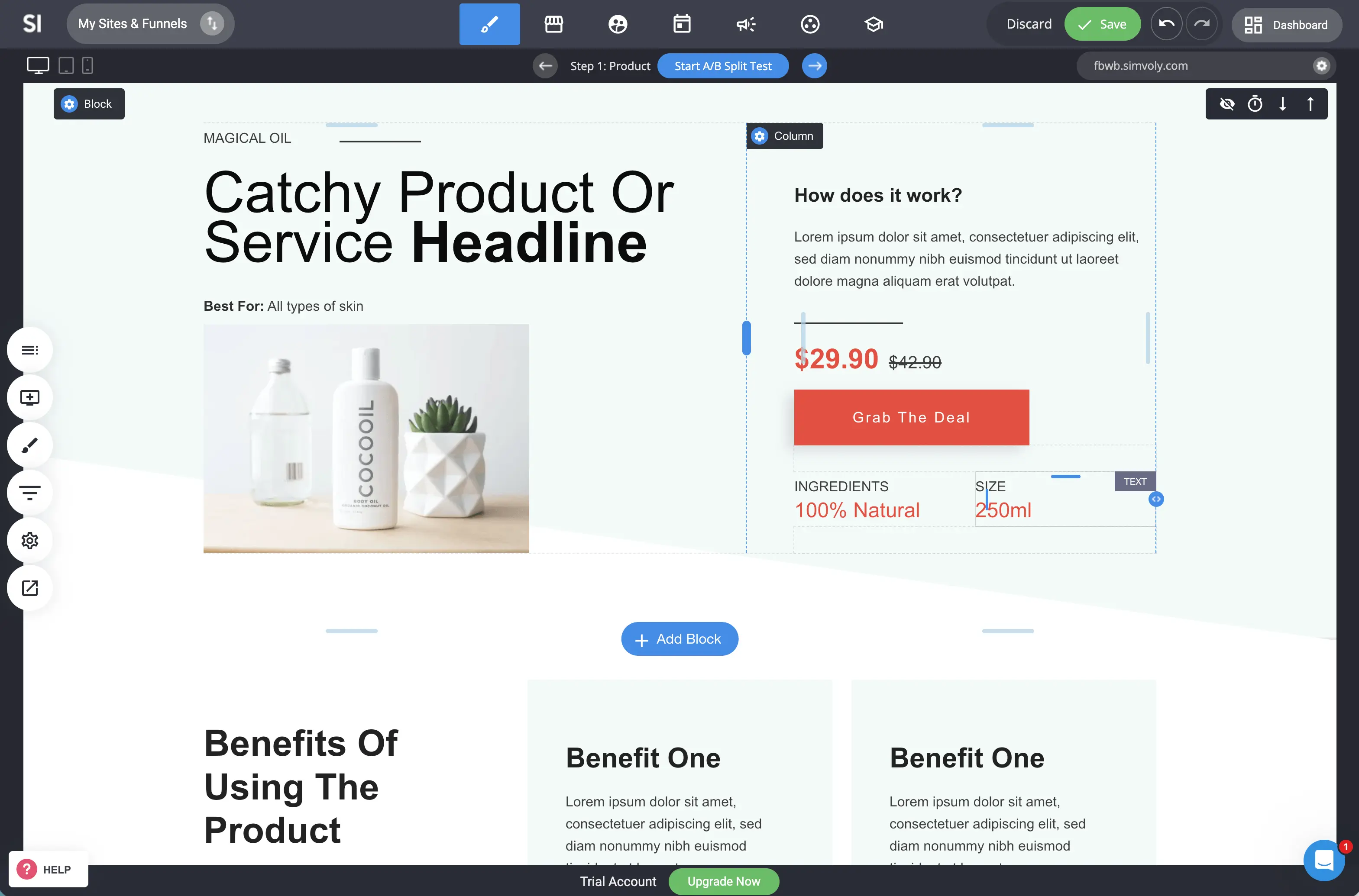
This is where our assessment diverges most sharply from the published reviews, several of which score Simvoly above 4.5 for ease of use. Taken narrowly, they are not wrong: the page editor is a competent drag-and-drop canvas, widgets snap into place, and an AI-assisted setup wizard can scaffold a first draft from a short description. If you judge Simvoly by ten minutes in the editor, it feels easy.
The Dashboard Is the Problem
Judge it by an afternoon of real work and a different picture emerges. Simvoly separates websites and funnels into distinct objects with their own pages, settings and analytics, and layers a store, a CRM, marketing automations, communities, video and appointments alongside them. The result is that the control you want is routinely somewhere other than where you are working, and the platform does little to signpost which area owns which setting. Confusing navigation is the single most consistent complaint in independent user feedback, and it matches our own experience precisely. One Capterra reviewer put it plainly: it is a little confusing to figure out where a lot of the settings are.
You Design Every Page Three Times
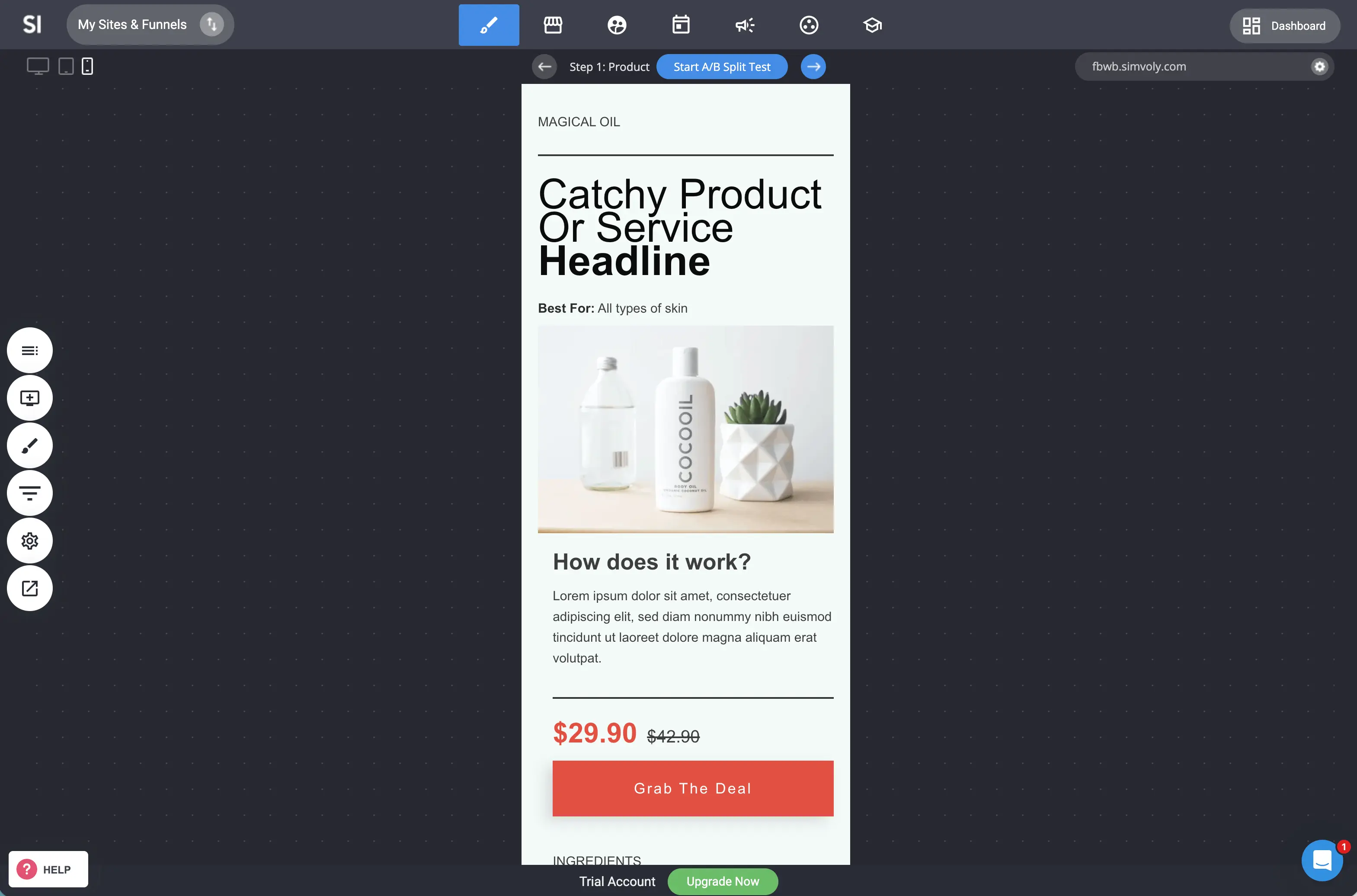
The heaviest practical cost is responsive design. Simvoly gives you separate desktop, tablet and mobile views, and rather than adapting your desktop layout automatically it frequently hands you a broken mobile version to fix by hand. That is not a one-off setup tax: every subsequent edit has to be repeated in all three views. Users describe this in almost identical terms across Capterra and Software Advice, one noting that you basically need to design the same page three times. Builders like Wix, Squarespace and Dorik handle the majority of this for you and only ask for manual intervention on genuinely awkward sections.
No Mobile Editing
There is no Simvoly mobile app, and no usable way to make edits from a phone. Multiple users also report that font changes made in the mobile view do not always take effect, which is a particularly unwelcome bug given how much time the platform requires you to spend in that view. We score ease of use 3.0: the editor is fine, the platform around it is not, and the responsive workflow actively costs you time on every change you ever make.
Design & Templates
Simvoly currently advertises 200+ page templates, 200+ content blocks and 100+ funnel templates, plus 30+ widget types and around 900 fonts. Worth flagging: a widely read review still describes Simvoly as having "50+ responsive templates", a figure that is years out of date. If you are comparing platforms on template counts, check the vendor's own site rather than trusting the review roundups.
Conversion-Focused, Not Design-Led
The templates lean commercial: hero, benefits, testimonials, pricing, call to action. They are clean and they convert, which is the point, but they are visibly a step behind what Squarespace and Framer ship. Typography is safe, spacing is generic, and a Simvoly site tends to look like a Simvoly site. Global styling for colours, fonts and buttons works well and propagates properly, and the block library makes assembling a long sales page quick. Custom code injection is available if you need to go past the built-in controls.
Responsive Output Is the Weak Link
A template will render correctly across devices out of the box. The moment you customise it meaningfully, the manual per-device workflow described above becomes your problem. That is a design shortcoming as much as a usability one, because the realistic outcome for a busy user is a desktop layout that looks polished and a mobile layout that quietly does not. Given that Google indexes mobile-first, that is not a cosmetic issue. We score design 3.5: a solid, broad library held back by average visual polish and responsive handling that offloads work onto you.
Features
Feature breadth is Simvoly's genuine strength, and it is the reason the platform deserves a serious look despite everything above. The funnel builder is the standout: multi-step sequences, one-click upsells and downsells, order bumps, A/B split testing between funnel versions, and per-step analytics showing where people drop out. Almost no general-purpose website builder offers this. On Wix or Squarespace you would be bolting on a third-party funnel tool and paying separately for it.
CRM, Email and Automations
Simvoly includes a working CRM at no extra charge: contact profiles with tags, custom properties, activity logs, segmentation and form submission tracking. Marketing sits on top of it with a drag-and-drop email builder, broadcast campaigns, subject line A/B testing, SMS and WhatsApp messaging, and automation flows with conditional logic. Email sending allowances are tied to your plan (12,000 messages a month on Premium, 30,000 on Elite) and extra subscriber capacity is a paid add-on starting at $9 a month, so a serious list will cost more than the headline price suggests.
Memberships, Courses and Booking
The platform also handles gated membership areas, courses with progress tracking, community walls and discussions, native video hosting with its own player and analytics, quizzes for lead capture, and appointment scheduling with operator assignment, group sessions, calendar sync and custom intake questions. Hosting runs on Amazon infrastructure with daily backups. For a coach or course seller this replaces a genuinely expensive stack. Be aware that user feedback describes the membership tooling as clunky, so budget setup time.
The Integration Gap
One real hole: there is no app marketplace. Where Wix has hundreds of installable apps, Simvoly expects you to route third-party connections through an external connector service such as Zapier. Users specifically ask for shipping carrier integrations and marketing tools that are not there. So the bundled features are broad, but you cannot extend past them the way you can on a platform with a developer ecosystem. We score features 4.2, high for this list, on the strength of what is included rather than what can be added.
SEO Tools
Simvoly covers the fundamentals and stops there. You can edit page titles, meta descriptions and URL slugs, set image alt text, and rely on automatically generated sitemaps. Free SSL is included on every plan, hosting on Amazon infrastructure is respectably fast, and Simvoly does optimise page delivery. For a local business, a service page or a funnel that gets its traffic from paid ads and email, that is a perfectly adequate baseline.
What Is Missing
Every independent source we checked reaches the same conclusion, and so did we: SEO control does not extend far past meta tags. There is no proper redirect manager, no canonical tag editing, no control over structured data beyond what the platform emits on its own, no hreflang handling, and no built-in audit or keyword tooling. If you migrate an existing site to Simvoly, the absence of solid redirect management is a real risk to rankings you already have.
The Mobile Indexing Risk
The manual responsive workflow compounds this. Google has indexed mobile-first for years, so if your mobile layout has drifted out of sync with desktop (which is the default outcome when every edit must be repeated three times) the version Google actually judges is the one you paid least attention to. If organic search is your main acquisition channel, WordPress.com or Wix give you materially more control. We score SEO 3.0.
Ecommerce
Simvoly's store is more capable than most builders in this price range. It handles physical goods, digital downloads, services and membership products, with product variations, inventory tracking, discount and promo codes, configurable tax and shipping rules, recurring payments and subscriptions, and customisable checkout pages. Fifteen payment processors are supported, and Simvoly takes 0% in platform transaction fees on Premium and Elite, so your only deduction is the processor's.
Funnel Commerce Is the Real Advantage
Where Simvoly pulls ahead is the join between store and funnel. Order bumps at checkout, one-click post-purchase upsells and downsells, and A/B testing on the checkout flow itself are standard here and largely absent from Wix or Squarespace stores. If you sell a small catalogue with deliberate upsell paths, this is a better-designed system than the product-grid approach most builders take.
The Limits, and the Real Price
Ecommerce is gated to the Premium plan at $39 per month billed annually ($49 monthly), capped at 100 products; unlimited products need Elite at $79 annually or $97 monthly. Note that several prominent reviews still quote a $26 per month ecommerce tier, which is around a third below the real figure. Beyond price, there is no bulk product import, which makes migrating a catalogue of any size painful, and shipping carrier integrations are a recurring user request rather than a feature. For a large catalogue or serious logistics, Hostinger, Squarespace or a dedicated platform like Shopify remain better answers. We score ecommerce 3.6.
Pros and Cons
Pros
- Genuinely broad feature set: websites, sales funnels, CRM, email marketing, memberships, courses and appointment booking in one subscription
- Funnel builder includes A/B testing, one-click upsells and downsells, and per-step analytics, which most website builders do not offer at all
- Ecommerce goes deeper than the category average: product variations, digital downloads, recurring payments, discount codes, tax and shipping rules
- 0% platform transaction fees on the Premium and Elite plans, with 15 supported payment processors
- Large building-block library (30+ widgets, 200+ page templates, 200+ block templates, 100+ funnel templates, 900+ fonts)
- Competitively priced white label tier for agencies and resellers, starting at $59 per month billed annually
- 14-day trial needs no credit card, and Simvoly allows a fresh trial per project
Cons
- No free plan of any kind, which is unusual on this list and the main reason for our low free plan score
- Confusing to navigate: settings are scattered across separate site, funnel, store, CRM and marketing areas, and the platform assumes you already know which one you need
- Responsive design is manual. Desktop layouts frequently do not carry over, so you end up designing and re-editing the same page three times for desktop, tablet and mobile
- No mobile editing app, and font changes in the mobile view do not always apply
- SEO control barely goes past meta title and description, with no meaningful redirect, canonical or structured data tooling
- Ecommerce is locked to the Premium plan at $39 per month billed annually, not the entry tier that most published reviews still quote
- Third-party integrations mostly route through an external connector platform instead of a native app marketplace, and there is no bulk product import
- Support is live chat and contact form only, with no phone line, and users report multi-day resolution on complex issues
- Only 11 Trustpilot reviews, so independent, unsolicited feedback on the platform is thin
Simvoly Pricing
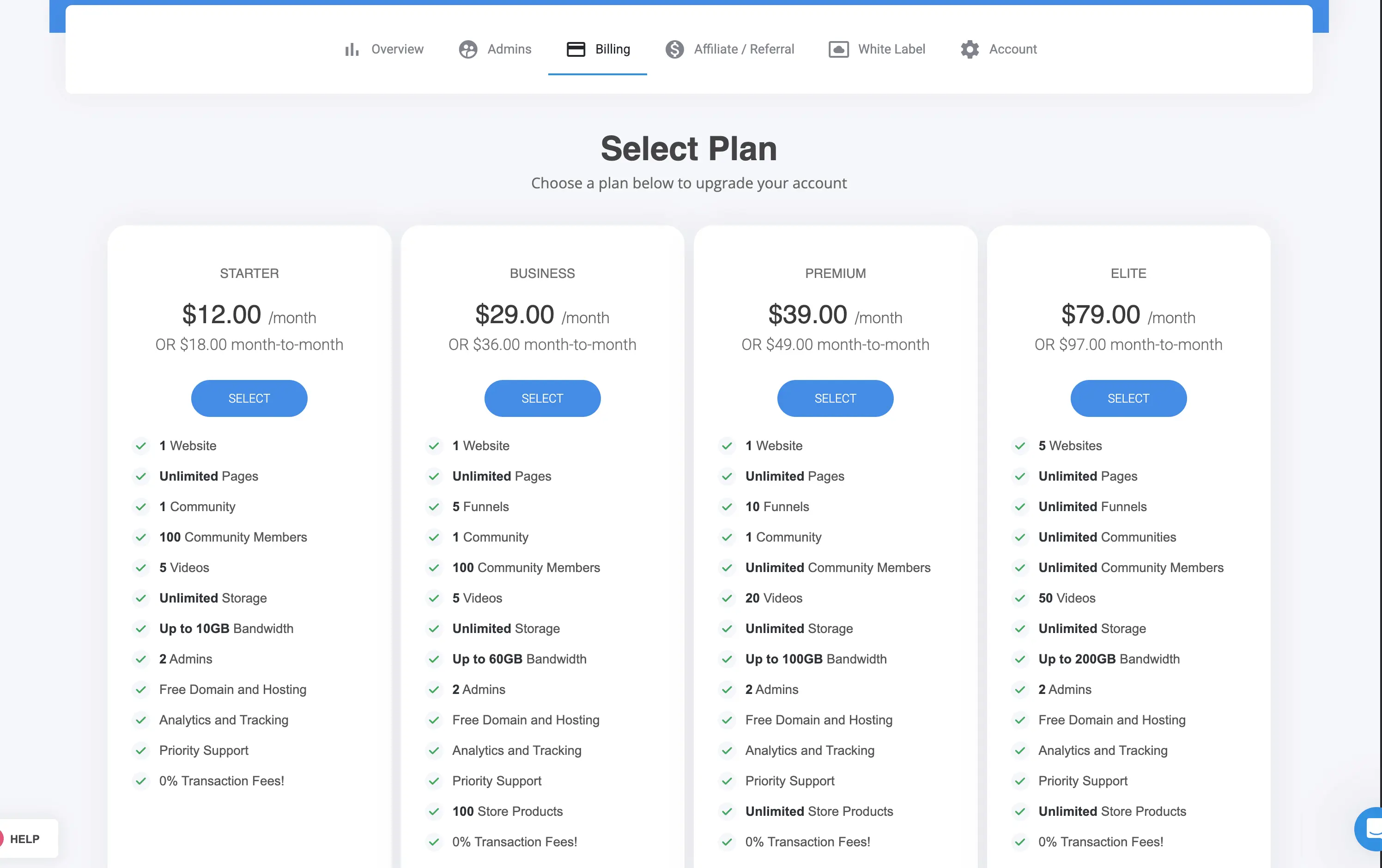
Prices below were checked against Simvoly's official pricing page in July 2026. Annual billing is the discounted figure and includes one free year of a domain; monthly billing costs noticeably more. Storage is unlimited on every plan, bandwidth is not.
| Plan | Annual | Monthly | Key Limits |
|---|---|---|---|
| Free Trial | $0 | $0 | 14 days per project, no card required, no custom domain |
| Starter | $12/mo | $18/mo | 1 website, no funnels, no store, 20 GB bandwidth, 100 subscribers |
| Business | $29/mo | $36/mo | 1 website, 5 funnels, no store, 60 GB bandwidth, 100 subscribers |
| Premium | $39/mo | $49/mo | 10 funnels, store up to 100 products, 0% fees, 12,000 emails/mo, 1,000 subscribers |
| Elite | $79/mo | $97/mo | 5 websites, unlimited funnels and products, 30,000 emails/mo, 2,500 subscribers |
| White Label Basic | $59/mo | $69/mo | 2 websites, 10 funnels, platform rebranding, 500 subscribers |
| White Label Advanced | $129/mo | $149/mo | 5 websites, unlimited funnels, affiliate program, academy |
| White Label Ultimate | $429/mo | $497/mo | Unlimited websites and funnels, 1 TB bandwidth, 10,000 subscribers |
Two things to watch. First, the Starter plan at $12 a month sounds cheap but excludes funnels and the store, which are the reasons most people choose Simvoly in the first place; the realistic entry point for the full product is Premium at $39 a month annually. Second, email subscriber capacity is a separate add-on running from $9 a month upward, so a growing list pushes the true cost well past the plan price. Annual plans carry a 14-day money-back guarantee. Monthly plans do not, which is worth knowing before you pick the flexible option.
Final Verdict
Simvoly is a capable platform that is genuinely hard to recommend to the audience most likely to find it. The funnel builder, CRM, email automations and membership tooling add up to real value, and bundling them at $39 a month undercuts assembling the same stack from separate vendors. Nothing about the feature list is dishonest.
The problems are structural rather than cosmetic. There is no free plan, so you cannot live on the platform before committing. The dashboard spreads related settings across separate site, funnel, store, CRM and marketing areas with little guidance, which is why "confusing" is the most repeated word in independent user feedback and was our own reaction too. Responsive layouts are hand-maintained across three device views, so every future edit costs three times what it should. SEO control barely reaches past meta tags. And the platform's own marketing now points at agencies and resellers, not at individuals.
We score Simvoly 3.0 out of 5. That is lower than the 4.4 to 4.8 you will see on affiliate-funded and vendor-solicited review sites, and the gap is mostly two things those scores understate: the total absence of a free tier, which carries the heaviest weight in our scoring, and the real cost of the per-device responsive workflow once you are past the first hour.
Best For
Agencies and freelancers who want to resell a white-labelled platform to clients. Coaches, course sellers and marketers who need a funnel, an email sequence and a CRM behind one page and would otherwise pay three vendors. Anyone whose priority is conversion mechanics rather than visual design.
Not Suited For
Anyone who needs a free plan, anyone building a single straightforward website, anyone who cares about design polish, anyone whose traffic depends on organic search, and anyone running a catalogue large enough to need bulk imports or carrier shipping. For a simple site, try Webador or Wix. For design, Squarespace or Framer. For a real store, Hostinger.
Frequently Asked Questions
Does Simvoly have a free plan?
Why is Simvoly considered confusing when most reviews call it easy?
Is Simvoly good for SEO?
How much does Simvoly ecommerce actually cost?
Who is Simvoly actually built for?
How does Simvoly compare to Wix or Squarespace?
Trustpilot Score
Based on 11 reviews on Trustpilot
Simvoly holds a 4 out of 5 rating on Trustpilot as of July 2026, but from only 11 reviews. That is far too small a sample to draw conclusions from, and it stands out against the tens of thousands Wix and Hostinger have accumulated. The reviews that are there are mixed: praise for the all-in-one breadth and recent integration work, complaints about technical issues including image quality handling. Trustpilot is the one major review site here that Simvoly appears not to have solicited heavily, which is precisely why the thin volume is worth noting rather than dismissing.
View Simvoly on TrustpilotWhat Other Reviews Say, and Why We Score Lower
Search for a Simvoly review and you will find scores between 4.4 and 4.8 out of 5. We landed at 3.0. Rather than ask you to take our word for it, here is what we found when we examined those sources.
Most of the Top Results Are Affiliate-Funded
Nearly every high-ranking Simvoly review earns a commission on sign-ups, and several disclose it openly. That does not automatically make them wrong, but it does explain a pattern: the friction that only shows up in week two of real use gets less airtime than the feature list does. Note also that we operate affiliate links ourselves, which is disclosed site-wide. The right response to that is verifiable claims, not a promise of purity, so every price and limit in this review is checked against Simvoly's own pricing page rather than repeated from another review.
Some of the Data Is Simply Out of Date
This is the most concrete problem. One of the most widely read Simvoly reviews still lists plans at $12, $18 and $26 a month with ecommerce on the top tier, and describes the platform as having 50+ templates. As of July 2026 the real ladder is $12, $29, $39 and $79 annually (higher monthly), ecommerce starts at $39, and Simvoly advertises 200+ page templates. A prospective buyer using that review to budget an online store would be roughly 50% short on the monthly cost. Stale pricing is the single most common defect we found across these sources.
Three "Independent" Sites Are One Review Pool
Software Advice shows 4.8 out of 5 from 72 reviews. Capterra shows 4.8 out of 5 from 72 reviews. GetApp carries the same set. That is not three sources agreeing; Capterra, GetApp and Software Advice are all owned by Gartner Digital Markets and share one review pool. Treating them as corroboration inflates confidence in a single dataset. On top of that, Simvoly ran heavily discounted lifetime deals on AppSumo, and lifetime-deal buyers are a famously enthusiastic, self-selected cohort. Vendor-solicited reviews and a lifetime-deal user base both push scores up for reasons unrelated to how the product performs for a new full-price customer.
Where the Sources Actually Agree
Read past the scores and the criticisms converge, which is the most useful signal available. Independent of each other, reviewers on Capterra, Software Advice and elsewhere report the same three things: the interface is confusing to navigate, you must design each page separately for desktop, tablet and mobile and then repeat every edit three times, and SEO control does not extend far past meta tags. Support channels are consistently described as live chat and contact form only, with no phone option. Those four findings appear regardless of who is being paid by whom, and they carry the most weight in our assessment.
One source we could not check directly: PCMag's Simvoly review blocks automated access, so we have not represented its conclusions here either way.
Our Hands-On Experience
We signed up for the 14-day trial and set out to build a small service business site: a home page, a services page, an about page and a contact form, then a simple two-step funnel behind a lead magnet. The AI setup wizard produced a usable first draft quickly, and our early impression matched the positive reviews. The drag-and-drop canvas is responsive, widgets behave predictably, and global styling for colours and fonts propagated cleanly across pages. For the first hour, Simvoly felt easy.
The impression did not survive the afternoon. Our persistent difficulty was knowing where anything lived. Simvoly treats a website and a funnel as separate objects with separate page lists, settings and analytics, and layers the store, CRM, marketing and appointment modules alongside them. More than once we went looking for a setting in the site area and found it under the funnel, or the reverse. Nothing was broken; we simply spent a large share of the session orienting rather than building, which is not an experience we had on Webador, SITE123 or Durable.
The bigger cost was responsive design. Our desktop home page looked good. Switching to the mobile view showed a layout that needed real repair: stacking that did not make sense, oversized headings, spacing that had to be reset by hand. We fixed it, then changed one headline on desktop and had to fix the mobile and tablet views again. This is the complaint users describe as designing the same page three times, and it is accurate. Compounding it, font size adjustments in the mobile view did not consistently take effect, which cost more time than the layout work itself. There is no mobile app, so none of this can be done away from a desktop.
What impressed us was the funnel builder. Chaining a lead magnet page to a thank-you page with an upsell offer took minutes, the A/B testing setup was clear, and the step-by-step analytics answered the question a marketer actually asks. This is where Simvoly's design intent shows through, and it is meaningfully better than adding a third-party funnel tool onto Wix or Squarespace. The CRM picked up form submissions immediately and tagging worked as expected.
Our overall conclusion is that Simvoly's difficulty is a mismatch problem rather than a quality problem. The platform is built for someone running many client projects across sites, funnels, lists and stores, and for that person the breadth is the whole point. Coming to it to build one website, we paid the full cost of that breadth and used a fraction of it. The parts we needed most (a clean responsive layout and basic SEO control) were the parts Simvoly handles least well. Two weeks was also not enough to properly evaluate the membership and automation tooling that would have justified the price, and with no free tier there is no way to keep exploring at your own pace.